

How Long Do Puppies Chew?
The following is an excerpt from Petfinder’s FurKeeps Kickoff Live Facebook Q&A.
Q: My 2 1/2-year-old Greyhound tries to eat things like napkins, Kleenex, etc. She also chews on baskets and some of the kids’ toys.
Is this still puppy behavior? How can I stop it?
A: Your Greyhound is too old to be teething, so chewing is just something she finds rewarding. Some dogs are “hard chewers” all their lives — think Pit Bulls and Labs. You don’t see it as much in Greyhounds, but that just goes to show that each dog is an individual.

You can also try taste-aversives on things like the baskets. Use bitter apple furniture cream on wood or wicker and the pump spray on fabric. There are other brands on the market as well if you find she likes the taste of rubbing alcohol and crabapple juice.
Chewing and Destruction
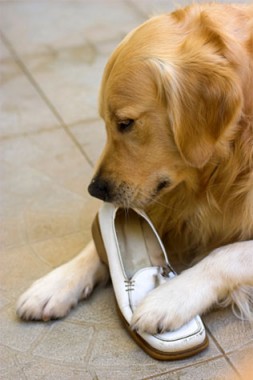
Let’s first look at why dogs chew. Puppies have sharp little “milk teeth” and not only do puppies enjoy chewing as a means to relieve stress but they need to chew to alleviate aching gums and later to loosen those teeth when it is time to fall out. Some puppies can teethe until they are 9 to 12 months although many will be finished and have a complete set of adult teeth by this time.
Older dogs should have acceptable chew objects to keep those teeth healthy. Certainly not all chew toys are created equal so ask your veterinarian for recommendations for safe and effective chew objects. When adult dogs chew on appropriate items it can be like us flossing. It cleans excessive plaque off the teeth and feels pretty good. They were given strong jaws and teeth to chew through bones. Nature would have these opportunistic scavengers getting nutrition wherever they could find it. So bones have a lot of value to them. It is important to give bones that are suitable for dogs. Consult your veterinarian for ideas on using bones to make sure they are appropriate size and type for your dog. You should never give cooked fowl bones to dogs because of the high risk of choking and splintering.
We now know not only do dogs enjoy chewing but they need to for a number of different reasons. Outside of the desire to chew, dogs explore the world through scent and by using their mouths. We pick up objects, eat and play by using our hands. Dogs use their mouth for all three of these activities. When you bring a new dog into your home whether it is a puppy or adult you should follow a few key steps to make sure they don’t chew on the wrong things.
STEP 1: PROOFING YOUR HOME.
Make sure anything that is valuable or dangerous is put away when you bring a dog home (shoes, electric cords, toxic plants, dish towels, etc). Get down on the ground and look for anything hanging down that looks like it would be fun for a dog to play with or chew.
STEP 2: FIND TOYS.
Find objects that the dog likes to chew on (toys,appropriate sized bones that do not splinter, puzzle and feeder toys) and praise your dog every time he chooses the correct objects to put in his mouth.
STEP 3: EXERCISE.
Alleviate a bored dog and anxious mind by giving your dog a big exercise outlet prior to down time, preferably one where he can use his mouth in a positive way like fetch and structured tug games.
STEP 4: DROP IT.
Teach your dog a solid “drop it” command so when he picks the wrong object he is happy to let it go for another object or treat.
After a few weeks the dog will develop a routine of the objects he likes to put in his mouth. Keep mixing up the routine by adding objects and hide old favorites from time to time so when you bring it back he thinks, “oh yeah, I forgot about that one, I love that”. The best defense against chewing and destruction is a good offensive game plan. Show your dog what kinds of objects are acceptable to chew and you will prevent a lot of destruction and unnecessary frustration.
Barking When Left Alone
Of all dog behavior problems, perhaps the most distressing one is the dog who barks when left alone. Incessant volleys of yips, woofs and whines are an irritant to those who live in close quarters or for those who need some peace and quiet in their life! These latchkey barkers fit several profiles. It is important to determine which one or more describes your dog; misreading the dog may result in a failure to extinguish the problem.

Virtually all terriers and many small dogs, particularly Maltese, Poodles and miniature Schnauzers, fit into this category. These breed types have been pre-programmed to bark at movement or noise within their range. Sensitive alarm barkers once bred to alert the farmer of the fox in the hen house now announce that the phone is ringing, the neighbors are home or that the elevator has arrived. They must be trained to limit their barking. Training them to bark on command gives you control; you can turn it “on” or “off” on your orders! It’s not that you don’t want them to bark; you just want them to be appropriate. Find a suitable place or time where the yappy dog can bark to his heart’s content.
2. The Alpha/Territorial
These barkers are most often unneutered males and/or guarding breed types. They believe that they are protecting their yard, house and general “air-space” from intruders such as the mailman, a squirrel, a passing dog or a neighbor. Neutering may take the overprotective and/or territorial edge off the intact dog. Training will get the genetically protective dogs’ instincts in line. Blocking the dog’s view of the property lines (stockade instead of chain-link fencing) and keeping him from patrolling the area around the front door or front porch may assist in cutting down the owner-absent barking. Monitor this type of dog carefully; do not permit him to bark at passersby when you are home. If you cannot silence him when you are there, you can’t expect much when you’re not.
3. The Demanding Barker
This confident soul does not want to be left alone because the fun stops. He stands at the door and commands you to return to play with him. Both barking set-ups (explained below) and engaging toys work well to quiet this imp’s demands, as does the citronella anti-bark collar.
4. The Bored Underexercised
Sporting, hound and herding breed types were bred to work all day long. Many retrievers, pointers, setters, collies and the like now find themselves sadly under-exercised, especially in the urban environment. These dogs need to be kept busy. If not, boredom turns into barking (not to mention chewing, pacing and digging). Most need at least two hours of vigorous, aerobic exercise a day. If you are going to be gone for an extended period of time (over six hours,) an hour of mentally challenging and physically active fun and games is mandatory. You should leave behind a panting, heaving, utterly exhausted dog as you set off for the day. Offering them breakfast from a stuffed KongTM or food-dispensing toy can also keep them busy.
5. The Fearful, Anxious Dog
Some of these dogs fall into the category of toy and miniature breed types. Dogs that have been passed around from home to home and shelter rescues also fit into this group. Their histories may include coddling and over-protective handling, lack of proper socialization or isolation. Dogs that have never been out of the back yard or permanently paper trained apartment dwellers are candidates for anxiety behaviors if placed in a new home environment. These dogs suffer from separation anxiety when left behind, even for brief periods. Chewing, barking, house soiling and digging at doors or window sills are some typical responses. The majority of these dogs need to be properly socialized to the world around them. Obedience work with plenty of praise builds confidence, yielding a more stable dog; a dog with a better ability to cope.
Environmental Changes to Minimize Owner Absent
The anxious dog may feel less stressed-out when home alone if he’s confined to a kennel crate either the enclosed airline type (molded plastic) or a wire crate draped with a sheet or a tablecloth. With less space to worry about just the bed and a chew toy many dogs just curl up and calm down. A word of warning regarding dogs with severe anxiety problems (often a rescue/shelter dog): some dogs may go to pieces in a crate; they will shake, slobber, struggle and exhibit extreme escape behavior. In these instances you must seek the counsel of a professional dog trainer or applied animal behaviorist who is well versed in canine behavior problems and can customize a program for the dog that may include short-term drug therapy.
Barking Set-Ups
Keep the dog in the quietest part of the house. A dog with behavior problems has not earned “the run of the house”.
Keep curtains and/or shades drawn. If you don’t have adequate window coverage, get some; hang a sheet or blanket across the window. A darker environment has a calming effect on most dogs. Additionally, there is no visual stimuli to provoke the territorial or bored dog. Curtains muffle sounds from the outdoors for alarm barkers.
Leave a radio or TV on as white noise. In many households, the stereo/TV/radio is on from morning ’til night as long as someone is home. Imagine how “loud” the silence is when everyone is gone and the sound system is turned off! Beyond masking outside noises, leaving the stereo/TV/radio on gives the aural appearance of your presence.
As you leave, give the dog an “only-when-I’m-gone” chew toy with your scent imparted on it. This toy should be something spectacular – a sterilized beef bone stuffed deeply and thoroughly with canned dog food or cheese spread (served frozen or chilled), a flavorful beef-basted knotted rawhide bone, or a stuffed KongTM. Give it to the dog upon leaving; rub it between your palms several times before you go. Not only is this a diversion tactic, it actually makes being left alone not so bad, as this is the only time the “most-wonderful-thing-in-the-world” appears!
If you have tried all of the above and you are still finding notes from your neighbors, you must desensitize the dog to your departures with “barking set-ups.” Set-ups take time; slow incremental progress is a necessary part of the program. Be prepared to use a long week-end or some vacation time for the program.
First, imitate your daily departure routine. Do you usually put on make-up, search about for keys, gloves, etc. pack a gym bag or throw out the garbage? Make the dog think that this is just like any other daily departure.
Second, while giving him his special goodbye toy, get eye contact and tell him in a firm and matter-of-fact manner to be quiet until you return. Please, no longwinded emotional scenes; no begging, pleading or whining for him to be quiet. It will only serve to emotionally charge the situation and further stress-out the dog.
Leave for a brief period of time. Just a minute or two to start out with. If you wait for an elevator, ring for it and get in. Go one floor down and come back up using the stairs. Wait 1-2 minutes. If the dog has not barked, return and gently praise. If you hear him begin to bark, mark the behavior by a sharp rap on the door with a solid object like a brass key ring and start timing again. Each time the dog barks, rap on the door and set the timer back to zero. It may take a half hour to get 1-2 minutes of silence. When you do, go in and praise. Leave 15-30 minutes later and repeat.
The goal, of course, is to be able to stay away for longer and longer periods of time without having to correct the dog for barking. The time away must be built up in small intervals. Set goals ( 5, 10, 15 minutes) and go back in and praise the dog if he remained quiet for the set amount of time. Don’t wait for an undetermined amount of time and correct the dog for finally barking. Silence must be praised. Appropriate behavior must be acknowledged.
Most dogs who can remain silent for two hours can usually stay quiet for an 8 to 10 hour work day. It is building up to that first hour or so that may take several days of set-ups to achieve. Barking problems are rarely solved in a day.
Barking set-ups can be tedious, but they usually work if you take the time to do them properly. Let your neighbors know that you are not ignoring their complaints; that you understand their discomfort and you are taking steps to correct the problem. Quite often, they will cut you a little slack if they know that their complaints have not fallen upon deaf ears.
My Dog Chases My Cat. How Do I Stop Him?
THE FOLLOWING IS AN EXCERPT FROM PETFINDER.COM’S FURKEEPS KICKOFF LIVE FACEBOOK Q&A.
Q: I have a 2-year-old male Dachshund/Pug mix and in the last four months he has decided that my four cats are perfect for chasing. He has two other dogs to play with, gets plenty of exercise, and still chases my cats. What am I missing? I know doxis have high prey drives, but why did he start chasing the cats in only the last four months?
A: It’s hard to say why you are suddenly seeing this chasing behavior when you never did before. I assume all the cats were residents before your dog got there? Be sure your dog’s exercise regimen is regular and very exhausting. Exercise can often solve a great many issues right off the bat!
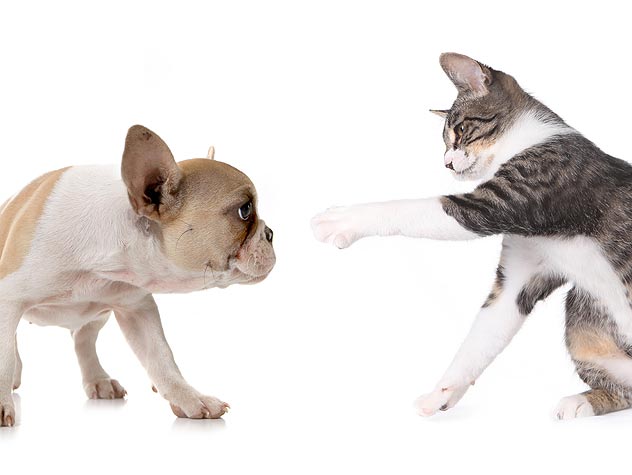
There is some inherent reward in the chase behavior, so the more your dog does it, the more well-versed he will become. This can become very serious, so being consistent in redirection and correction of this behavior before it starts over the next few weeks will really be important.
That said, I would also correct him if he gets fully into chase mode because you were not able to catch him in time to redirect him first. If he takes off chasing, you need to be right after him, using your voice as a correction tool. I want him to be immediately aware he has made a bad choice in chasing the kitty because Mom is very upset.
When you catch him, without emotion, put him into a room by himself or into his crate for a few minutes. You don’t need to hold a long grudge against him, but he needs to know that his chasing behavior has a serious consequence. Not only will you not allow it, he will have some time alone if and when he partakes.
If you have done any obedience work with him, use your recall (come, here, etc.) to work on calling him off. You may want to review his recall in contexts easier than cat-chasing at first so you can build a reinforcement history for coming when called. That way, you are likely to be more successful when he is otherwise distracted. This practice will help you outdoors as well with his daily recalls or off-leash behavior.
If you ever taught him a reliable “leave it” command, you can use that in this instance as well. Realistically, this takes lots of practice. He should be practicing lots of “leave its” in other contexts to help him understand what is expected of him so he has the best chance for success with the cat situation.
Always reward calm behavior in the presence of the cats. Any time they walk in and your dog is calm, reward like crazy with tasty tiny treats. This will help him make a nice, positive association with the presence of the cats. It will also help him learn to look to you when the cats are around rather than making his own choices about how best to deal with the cats!
I tend to be a little harsh with cat chasing as I have seen it turn into serious predatory behavior very fast — hence my suggestion for corrective measures in conjunction with the praise and reward for any good behavior that happens along the way!
Good luck!
Leslie Burgard
Dogs Think! Dog Training
Furnace, PA
Q: I have a 1-year-old Lab mix who is constantly chasing my cats. They hide in their little room all the time because they’re scared of him. Occasionally he’s jumped on them and pinned them down. He’s fine with the ferrets. Is there any way to stop this?
A: You can certainly suppress this behavior and eliminate it from your dog’s repertoire. The key is not to allow the dog to practice the behavior.
Chasing is very self-reinforcing for dogs. Basically, it is innately reinforcing. When I work with dogs and cats, I put the dog on a very strict training program, making sure the dog can recall away from any distraction. The dog must also be crated to give the cats time to wander. Lastly, the dog should be wearing a drag line so you can stop him from chasing the cats.
Supervision is critical. You can begin by having the cat in a carrier and permit the dog to be close (not too close) to the cat. Call your dog off the carrier and reward him with something he never gets, but loves. He needs to understand that coming to you is worth his while. Also, if he retrieves, I reward with a retrieve — in other words, I am putting the dog in chase mode, but chasing after the correct object.
How to Stop Dog Jumping
In January, Petfinder held a live Q&A on Facebook with pet trainers Andrea Arden and Mychelle Blake. Over the coming weeks we’ll be posting some of our favorite questions and answers here on the blog. Have a pet question? Check back regularly for news about our next live Q&A!
Q: How can I stop my dog from jumping whenever I put my jacket or sweatshirt on? She thinks she’s coming with me every time I leave the house. –Stacey B.
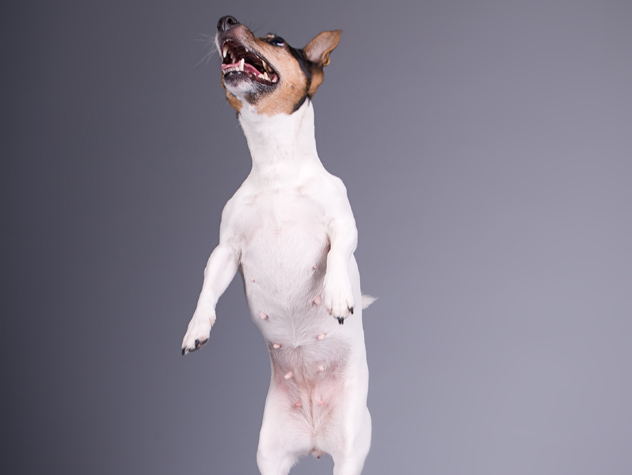
With any behavior issue, the first step is identifying the cause (we just did that!) and the second is using management to prevent the behavior from being practiced while you work on step three: teaching an alternative behavior which competes with the one you want to lessen. I would suggest a couple of techniques.
Use a high-value distraction: Have a toy stuffed with food your dog adores ready in a plastic bag in the fridge so you can get it right before you go to put your jacket on. Give it to your dog and odds are she will be enthralled with it to the exclusion of bothering you as you get ready to leave.
Practice the “wait” command: It sounds like your pup needs to work on impulse- or self-control. Throughout the day, practice waiting to give her a treat or her food or anything else she wants until she sits without you asking.
Teach “sit” as an alternate behavior: Teaching your dog to offer a sit without you asking is a wonderful way to allow her to become a problem solver. This way, she will learn to default to sit whenever she wants something.
In the case of you at the front door, I suspect your dog wants your attention and for you to take her out to play. Well, now she has a way of asking nicely!
Destructive Chewing
Four-month-old Jazzy, a “mostly Lab” puppy, has just been adopted by a newlywed couple. They head out to shop for supplies, leaving Jazzy free to explore her new abode. But after spending several days in a boring old cage at the shelter, Jazzy is bursting with energy and ready to examine the couple’s finery in great detail—by running it through her mouth. Two hours later, the newlyweds arrive back home to find feathers everywhere, not to mention a puppy with a very bad bellyache who requires a trip to the veterinarian. Can this adoption be saved before “Jaws” strikes again?
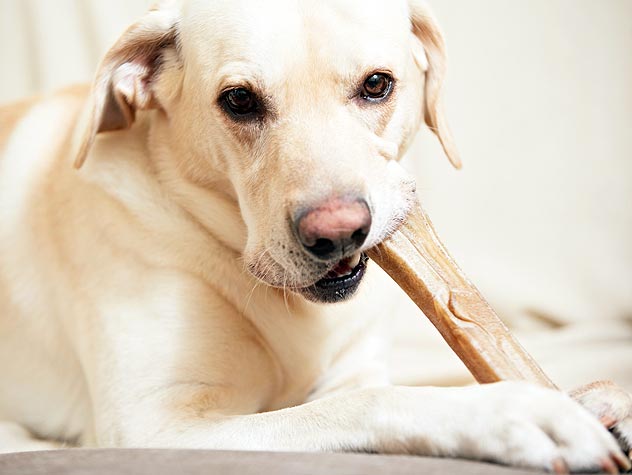
Dogs are apt to chew for several reasons. First, they are curious creatures who lack opposable thumbs. Hence, they cannot pick up most objects with their paws for closer scrutiny. Instead, they examine them with their mouths. Second, from four to eight months of age, they will shed all their deciduous (puppy) teeth and grow a new set of permanent teeth. Chewing assuages the discomfort that accompanies teething. Third, chewing expends energy and gives a bored pup something to do. Older puppies and young adolescents are bursting with energy. If not properly exercised, they may expend that energy gnawing on your family heirlooms. Fourth, dogs suffering from separation anxiety often chew objects embedded with their owners’ scents to help relieve the stress of being left alone. Finally, some dogs were purposefully bred to use their mouths. Retriever guardians are the group most likely to complain about excessive mouthing and chewing by their pups.
Take the Bite Out of Teething
It is possible to get through this difficult stage without major losses. The first step is to create a safe haven for your puppy. A dog crate or small, carefully dog-proofed area will do. When dog-proofing an area, get down at puppy eye level to scope out potential problems. Electrical wires, drapery cords, and curling wallpaper corners will jump out at you from this vantage point. When you cannot supervise your puppy, place her in her safe haven with an approved yummy chew toy, such as a rubber toy stuffed with kibbles or treats
Invest in a variety of chew toys appropriate to the size and chewing preferences of your dog. As the dog’s
guardian, the onus to select desirable yet safe chew toys falls on you. Items such as beef-marrow bones, rawhide, chew hooves, and pigs’ ears all have their pros and cons. The first few times you offer such items to your dog, watch closely to make sure they’re suitable for her. Throw away any sharp splinters or small, sticky remains. Alternate the chewies to keep her interest high, and save the most desirable of them for crate time or when the puppy is left alone.
Cue Good Behaviors
The only way a dog can learn which items are okay to chew and which ones are forbidden is by getting well-timed feedback from her humans. When she eyes or chews a table leg, give a verbal warning such as “eck” or “phooey” and then draw her attention to an acceptable toy. When you catch your dog chewing on an approved object, don’t forget to praise, reward with a tasty morsel, and tell her to carry on. Remember that rewarded behavior is more likely to be repeated. If the table leg or rug fringe remains your dog’s favorite chew toy, diminish its desirability by coating it with a commercial anti-chew cream (for wood) or spray.
It’s also important to remember that a young dog does not need access to the entire house. If you have children who are messy with their toys or a spouse who can’t seem to locate the dirty laundry bin, keep the dog out of those rooms by closing bedroom doors or installing pet gates during the dog’s chewing phase. Through a combination of management and training methods, assisted by the natural aging process, the Jazzys of the world will outgrow their “Jaws” nicknames and eventually earn full household access. Until then, make use of your dog’s safe haven when you aren’t there to supervise, and you’ll no longer fear what awaits you when you walk through the front door.
How Do I Stop My Dog From Chewing?
The following is an excerpt from Petfinder’s FurKeeps Kickoff Ask the Experts Forum.
Q: Unlike my Lab, who carries around her rawhide bones for days, weeks even, my parents’ female Lab chews them up in a few minutes.
How do we stop my parents’ dog’s aggressive chewing? She is overweight, so it’s not hunger. They live on a farm and she goes everywhere in the car with my retired parents.
A: I wish there was a solid great answer for your question. The bottom line is, every dog is different. Some are serious chewers and some are hobby chewers! It sounds like your dog is more of a hobby chewer and your parents’ dog is really dedicated to the task!
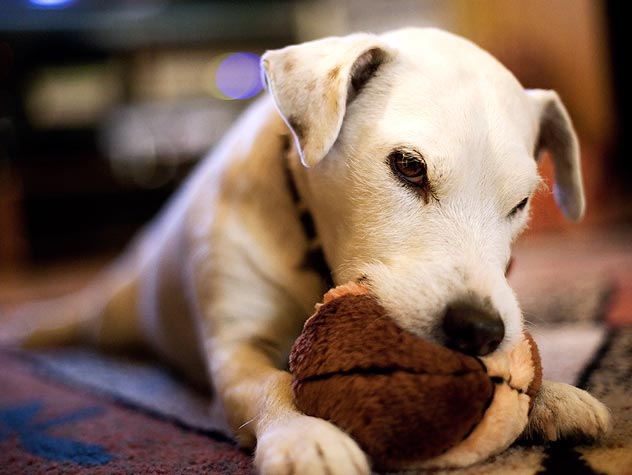
Regular rawhide tends to go very fast with a dedicated chewer so some suggestions for your parents’ dog would be to try some of the more indestructible toys like Kongs and Busy Buddy toys from Premier.
These toys are very hardy and are also interactive, so your parents’ dog will have to use her mind as well as her mouth to get through them. All of them can be stuffed with food to some degree and your imagination is the only thing that limits what you put into a well-stuffed Kong! Leftovers never go bad in my house as they get stuffed into a Kong and more often than not frozen to make the challenge that much tougher for my dogs.
Stuff the toys easily at first and then make it harder as the dog gets better at unstuffing them!
The other bones I like are the huge bronto bones — they are essentially cow femurs and are available in most feed stores and some better pet supply places. They look like a dinosaur bone really. They’re huge! If you hand her that outdoors or on a dog bed it should take her a while to make a dent in that. Of course, she should not eat the whole bone in one sitting. This would be a few days or a week of entertainment in my house, even with the power chewers sitting below my desk!
Bronto bones are generally hickory smoked so they have a coating that comes off. Be sure to avoid white carpets or nice dog beds until they lick and chew off all the good stuff.
My short-version advice?
The bigger the better with power chewers.
If she cannot get her whole mouth on the bone or toy to get a good chomp down that will help. The power comes from the back of the jaw so if she has to work at it at the front of her mouth, rather than being able to get it entirely inside, it may last longer.
If you stick with regular rawhide, look for big, industrial size ones — no smaller than 12″ in length. Pressed rawhide or something with multiple layers of rawhide rolled into a retriever roll is ideal.
If she consumes a lot, be sure to buy USA-made rawhides, as some of the other countries still use chemicals that are not ideal to consume in larger quantities!


|
A New Free Course on Dog Grooming Reveals the Secret Step-by-Step Techniques used by the best Dog Groomers in the country!
Finally, You Can Now Groom your Dog on your own at home without having to hire an expensive groomer! |