

The Power of Training Dogs With Markers
Motivating Your Dog
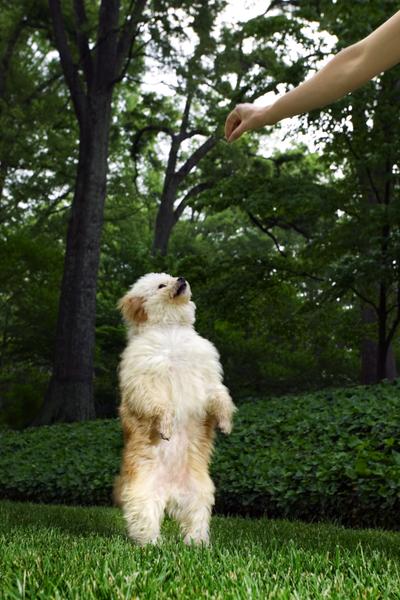
At the core of marker training is the knowledge that dogs will do what works to obtain the things they need. Food, water, attention, play and movement are just a few of these things. Using these resources as rewards, marker training motivates dogs to try different behaviors and skills until they find the one that works to obtain what they need or want. Because of this, we can teach dogs by focusing on the behaviors we like and rewarding them.
Removing the Confrontation
Marker training removes confrontation from the relationship between owner and dog. There is no use of force and no need to corner a dog into a response. Instead, marker training allows the dog to think independently and try new skills. Rather than control his dog’s every move, the owner can encourage the dog to make good choices. On occasion, trainers use a “no reward” marker to let the dog know the behavior was not worthy of a reward. Examples of no reward markers are phrases such as “wrong” or “try again” said in a relaxed, friendly tone to provide feedback, not to scold. However, removal of the reward, rather than introduction of the no reward, is often all that is needed to reduce an unwanted behavior.
Choosing a Marker
The most commonly used marker is the clicker, a small device with a metal tongue that makes a clicking sound when depressed and released. Speaking in more general terms, markers include words such as “yes!” and “good!” or short whistle bursts when working at long distances outdoors. When working with deaf dogs, many trainers have used vibration collars or laser pointers. Be careful with laser pointers, though, as these can excite dogs and trigger behavior problems. Whatever marker you choose, you must initially properly pair it with food treats so it has meaning to your dog. To do this, present the marker and immediately follow with a treat. Repeat until your dog is looking at you each time he hears the marker.
Consistent and Clear Communication
The biggest benefit to marker training is that it provides clear and consistent communication between owner and dog. Once the marker is charged, the dog knows that each mark means he gets a reward. Hence, this becomes an effective way for the owner to tell his dog which behaviors he likes. Using a camera analogy, each time the owner marks, the dog files a mental photo of what he did that earned that mark. And since dogs do what works, the dog will repeat behaviors that earn marks and abandon behaviors that do not.
Kathy Sdao’s SMART x 50
There is an easy method for applying marker training in daily life with your dog. Simply use the “SMART x 50” method developed by marine mammal and dog trainer Kathy Sdao. In her book, “Plenty in Life is Free,” Sdao describes how she developed this method for owners who did not have the time for formal, daily training sessions. SMART stands for See Mark And Reward Training. Count out 50 or more treats for each day. You can use part of your dog’s daily kibble if weight control is a concern. Then, each time your dog does something you like, for example going to his mat when the doorbell rings or sitting when approaching a stranger, mark happily with a word like “yes” or “good” and offer a treat. This method shifts your focus from what your dog is doing wrong to what your dog is doing right, and offers useful feedback to your dog as to what works.
Focusing on the Positive
Focusing on the positive builds a relationship based on trust, respect and fun with our dogs. No longer do we need to scare or physically harm our dogs in the name of training. Instead, guide your dog into making the right choices everyday, reward those choices with food or play and watch inappropriate behaviors disappear.
Information on Training a Yorkie

Features
Yorkshire terriers are a mix of several different terriers bred in Yorkshire to catch rats in clothing mills in the 19th century. Thus, they were owned largely by working-class individuals who needed a high-energy dog with an excellent prey drive. Though they rarely grow to larger than 7 lbs., they still have the energy of a rodent catcher and may use excess energy to remodel your house or yard (by chewing and digging, of course) if bored.
Considerations
Before adopting a Yorkie, recognize that you aren’t getting just a lap dog that will sleep all day. Yorkies need a lot of exercise and mental stimulation. A training program can help provide mental stimulation so begin to teach your dog boundaries, recall (come when called) and other tricks as soon as you bring it home. Yorkies also require a lot of grooming, including daily brushing if you are going to keep the long hair, so begin to teach it to tolerate grooming immediately. This can be done easily by brushing only a little and giving rewards. Keep the sessions short and build up to brushing the whole coat. Don’t let the coat get matted, or grooming will become very difficult on you and your dog.
Socialization
One major problem most Yorkie owners face is excessive barking. Yorkies are excellent guard dogs despite their small size, but an underexercised, undersocialized Yorkie can drive owners crazy barking at every noise. To avoid this, begins socializing your puppy as soon as you get it to everything you don’t want it to fear: men, women, children, walkers and crutches, hats, beards, skateboards, bicycles and so on. Make this a positive experience with lots of treats. When your dog barks, say “quiet” and reward it when it listens. If not, put your dog in a quiet room for timeout and ignore it until it’s quiet.
Potty Training
The other major problem facing Yorkie owners is potty training. Because Yorkies are small, they can hold their bladder for only an hour or less when they are puppies. Use a strict potty training regime by keeping a journal of when and how often your Yorkie relieves itself. When it is time, lead it outside (no carrying) through the door you want it to use. If your dog goes, give it a treat and let it back in the house for free time. If not, put your Yorkie in its crate until its next bathroom break. If your dog can hold it for an hour, repeat in an hour. Continue this until there are no accidents.
Training with Children
Many Yorkie breeders caution that Yorkies should not be placed in a house with small children, because they are so fragile and easy to injure. If you adopt a Yorkie and have children, don’t allow any roughhousing. Teach your children how to politely interact with the dog and always supervise any interactions. Teach your Yorkie to be calm around your children as well by keeping it on a leash and using timeouts if its behavior gets too excitable. Remember to give lots of additional exercise if using timeouts frequently.
Can a Dog Gate Help With Training?
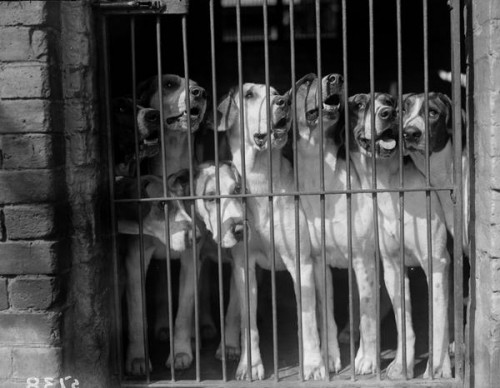
Use a dog gate to confine your dog to a single area of your home where he can stay when you can’t be there to supervise him. Make the area as safe as possible by removing potential hazards such as electrical cords and fragile items. Give him plenty of toys to keep him busy while he’s confined; a solid rubber toy stuffed with food is a good way to keep him occupied. Confining him with a dog gate takes away the opportunity for your dog to be destructive and helps to teach him what you want by providing him with nothing but acceptable alternatives.
Schools for Training Cadaver Dogs
Search and Rescue Dogs of the United States
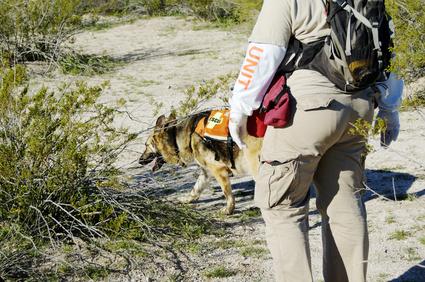
Search and Rescue Dogs of the United States trains dogs for Type 1 Human Remains Detection (HRD). With this training type, the qualifying dogs should be able to detect human remains within natural debris fields or wilderness areas within a 200 by 200 foot area. They should also be able to locate buried bodies within a 75 by 75 foot area. The dogs must exhibit self-sustainability for 24 hours and have the stamina to endure 12 hour search missions. At the conclusion of the course, the dogs and handlers must pass a standard HRD test.
Mountain View Dog Training
Mountain View Dog Training is owned and operated by dog training specialist Sheila K. McKee. Mountain View trains any working breed of dog for human remains detection but notes that retrievers often work best. Dogs should be 10 months to 2 years old with good social skills and in good health in order to complete the training. Training for HRD certification takes 160 to 200 hours. Mountain View uses FEMA Canine Search Readiness Evaluation Type II Elements, focusing on obedience, agility and directional control. While the school does not offer the HRD evaluation, it states that dogs trained there should be able to pass with little effort. Mountain View also offers an 80 hour handler training course, as well as lifelong handler/dog communication.
Highland Canine Training
Highland Canine Training offers both obedience and working dog training, including human remains detection. Highland Canine Training trains HRD dogs for both water and land detection. Dogs can be trained to alert handlers with an active move or a passive one. The facilities feature FEMA regulated agility courses, a rubble pile and a pond for training. Evaluation for a dog’s potential as a HRD dog is free of charge but the training courses, including handler training, do cost money.
Bear Search and Rescue Foundation
Bear Search and Rescue Foundation earns its name from the courageous rescue dog Bear, one of the first rescue dogs who headed to Ground Zero to seek out survivors and deceased persons after the 9/11 attacks. Following Bear’s passing, his owners created the foundation in order to train other dogs to follow in Bear’s footsteps. While based in New York, Bear Search and Rescue travels around the country teaching trailing and cadaver courses. The courses provided work for both beginners and higher level cadaver dogs. Introduction courses last about three days, while the intensive training courses last about four to five days.
How to Make a Clicker for Dog Training
1Save a small metal jar lid with a safety button. Safety buttons are the raised areas that pop up when you open the jar so you can be sure the container has not been tampered with. Baby food and pickle jars usually have suitable tops. It needs to be small enough to fit comfortably in the palm of your hand.
2Wash any food remnants off the lid and dry it. It’s worth preparing more than one, so you have a spare clicker on hand if the original gets damaged or lost.
3Push the safety button out farther with the hammer. Hold the head of the hammer against the underside of the button and hold firmly onto the lid while pushing with the hammer head. The bottom, not the sharp end, of a screwdriver or similar tool also works for this purpose. Enlarging the safety button increases the sound level.
4Test your clicker by pressing the button and push it out again until you are getting a loud click. Don’t worry if the lid becomes distorted.
5Hold the lid in the palm of your hand with the top side uppermost while training. Push the button with your thumb whenever you need to click.
Clicker Training Pros & Cons
Instant
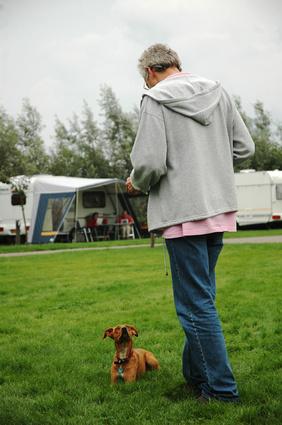
An advantage to using the clicker is that the reward is instantaneous. You can press the clicker much more quickly than you can give the dog a treat or even say “good boy.” As soon as the dog starts the good behavior, immediately click. That way, it’s completely clear to the dog what you are rewarding.
Eliminates Inflection
When you instruct your dog using words, the dog picks up on the tone of voice. Inflections can be confusing to the dog. This is especially true if more than one person is training the dog. Inflection, emotion and tone of voice are eliminated with the clicker. It always sounds exactly the same, no matter who is using it.
Conditioned
One problem with the clicker is that some dogs become conditioned to it and won’t obey commands without it. But the clicker is only meant to be a dog training tool. The dog should eventually be weaned off the clicker and taught to respond to voice commands. Once your dog begins consistently responding to the clicker, start using it less often.
Inconvenient
Some people find the clicker inconvenient to use. Holding the clicker along with dog treats and a leash can be cumbersome. The clicker is meant to be used the instant a dog exhibits good behavior. Having to juggle several objects before clicking defeats the purpose.
Dog Training Boot Camps

Intensive Training
While you might bring your dog to basic obedience classes once a week, working on exercises in the meantime, boot camp is far more intensive. Usually consisting of between one and two weeks of straight sessions, many canine boot camps require that the dog boards at the facility for that period. During part of that time, your presence is usually required. After your dog completes boot camp, some facilities recommend a series of private training sessions to reinforce and enhance your dog’s education.
Specialty Training
While all dog training boot camps provide basic training, most address specific behavioral problems in individual animals. These issues include aggression, destructive behavior, nuisance barking and housebreaking. Some canine boot camps offer sessions for training dogs in certain disciplines, such as hunting or guarding, rather than correcting canine problems. For example, if you own a bird dog, you might send him to a boot camp that works on retrieving training and conditions him to gunfire.
Typical Schedule
While canine boot camp schedules vary according to the facility, keeping to a strict schedule is part of doggie discipline. Typically, dogs receive at least two 20-minute training sessions daily, which includes exposing them to a variety of other canines. They also receive ample time for exercise, consisting of three or four workout opportunities of at least 20 minutes each. It’s important that dogs receive plenty of mental and physical exercise as part of their routine.
Becoming the Alpha
All the training in the world isn’t going to help your dog if you don’t learn how to become the alpha, or pack leader. A professional dog trainer observes your interaction with your pet, determining how your behavior affects your dog’s actions. In some camps, dogs spend the first week in retraining with the professional, while the second week consists of the professional training you and your dog together. In the best facilities, it’s dog and owner training boot camp.


|
A New Free Course on Dog Grooming Reveals the Secret Step-by-Step Techniques used by the best Dog Groomers in the country!
Finally, You Can Now Groom your Dog on your own at home without having to hire an expensive groomer! |