

Muttin’ but Love Fundraiser
The Muttin’ But Love Fundraiser benefits the non-profit organization’s commitment to rescuing at-risk dogs from Los Angeles area shelters, finding them safe and suitable permanent homes through adoption, advocacy and education.

The evening will feature drinks, entertainment, and live and silent auctions for remarkable items, including trips to Santa Fe and Lake Tahoe; spa services including Dry Bar, Sally Hershberger, B2V Salon, and Bliss Spa, plus Lakers, Clippers and Dodgers tickets.
Come and meet the editors of DOG FANCY, one of the event sponsors, who will share a sneak peek at Rescue Me, a soon to be launched new national publication dedicated to the world of rescue.
Destructive Chewing
Four-month-old Jazzy, a “mostly Lab” puppy, has just been adopted by a newlywed couple. They head out to shop for supplies, leaving Jazzy free to explore her new abode. But after spending several days in a boring old cage at the shelter, Jazzy is bursting with energy and ready to examine the couple’s finery in great detail—by running it through her mouth. Two hours later, the newlyweds arrive back home to find feathers everywhere, not to mention a puppy with a very bad bellyache who requires a trip to the veterinarian. Can this adoption be saved before “Jaws” strikes again?
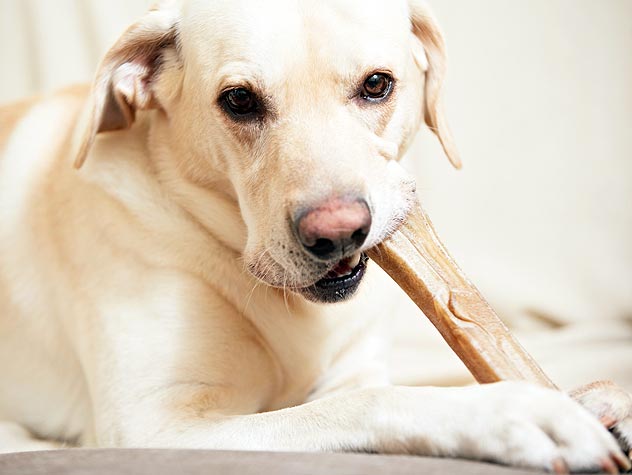
Dogs are apt to chew for several reasons. First, they are curious creatures who lack opposable thumbs. Hence, they cannot pick up most objects with their paws for closer scrutiny. Instead, they examine them with their mouths. Second, from four to eight months of age, they will shed all their deciduous (puppy) teeth and grow a new set of permanent teeth. Chewing assuages the discomfort that accompanies teething. Third, chewing expends energy and gives a bored pup something to do. Older puppies and young adolescents are bursting with energy. If not properly exercised, they may expend that energy gnawing on your family heirlooms. Fourth, dogs suffering from separation anxiety often chew objects embedded with their owners’ scents to help relieve the stress of being left alone. Finally, some dogs were purposefully bred to use their mouths. Retriever guardians are the group most likely to complain about excessive mouthing and chewing by their pups.
Take the Bite Out of Teething
It is possible to get through this difficult stage without major losses. The first step is to create a safe haven for your puppy. A dog crate or small, carefully dog-proofed area will do. When dog-proofing an area, get down at puppy eye level to scope out potential problems. Electrical wires, drapery cords, and curling wallpaper corners will jump out at you from this vantage point. When you cannot supervise your puppy, place her in her safe haven with an approved yummy chew toy, such as a rubber toy stuffed with kibbles or treats
Invest in a variety of chew toys appropriate to the size and chewing preferences of your dog. As the dog’s
guardian, the onus to select desirable yet safe chew toys falls on you. Items such as beef-marrow bones, rawhide, chew hooves, and pigs’ ears all have their pros and cons. The first few times you offer such items to your dog, watch closely to make sure they’re suitable for her. Throw away any sharp splinters or small, sticky remains. Alternate the chewies to keep her interest high, and save the most desirable of them for crate time or when the puppy is left alone.
Cue Good Behaviors
The only way a dog can learn which items are okay to chew and which ones are forbidden is by getting well-timed feedback from her humans. When she eyes or chews a table leg, give a verbal warning such as “eck” or “phooey” and then draw her attention to an acceptable toy. When you catch your dog chewing on an approved object, don’t forget to praise, reward with a tasty morsel, and tell her to carry on. Remember that rewarded behavior is more likely to be repeated. If the table leg or rug fringe remains your dog’s favorite chew toy, diminish its desirability by coating it with a commercial anti-chew cream (for wood) or spray.
It’s also important to remember that a young dog does not need access to the entire house. If you have children who are messy with their toys or a spouse who can’t seem to locate the dirty laundry bin, keep the dog out of those rooms by closing bedroom doors or installing pet gates during the dog’s chewing phase. Through a combination of management and training methods, assisted by the natural aging process, the Jazzys of the world will outgrow their “Jaws” nicknames and eventually earn full household access. Until then, make use of your dog’s safe haven when you aren’t there to supervise, and you’ll no longer fear what awaits you when you walk through the front door.
How Do I Stop My Dog From Chewing?
The following is an excerpt from Petfinder’s FurKeeps Kickoff Ask the Experts Forum.
Q: Unlike my Lab, who carries around her rawhide bones for days, weeks even, my parents’ female Lab chews them up in a few minutes.
How do we stop my parents’ dog’s aggressive chewing? She is overweight, so it’s not hunger. They live on a farm and she goes everywhere in the car with my retired parents.
A: I wish there was a solid great answer for your question. The bottom line is, every dog is different. Some are serious chewers and some are hobby chewers! It sounds like your dog is more of a hobby chewer and your parents’ dog is really dedicated to the task!
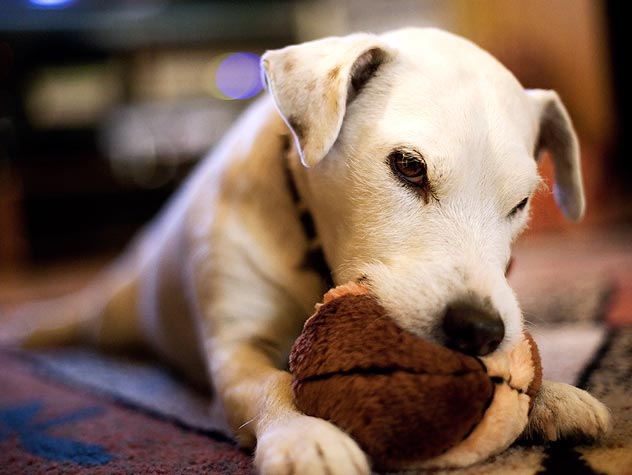
Regular rawhide tends to go very fast with a dedicated chewer so some suggestions for your parents’ dog would be to try some of the more indestructible toys like Kongs and Busy Buddy toys from Premier.
These toys are very hardy and are also interactive, so your parents’ dog will have to use her mind as well as her mouth to get through them. All of them can be stuffed with food to some degree and your imagination is the only thing that limits what you put into a well-stuffed Kong! Leftovers never go bad in my house as they get stuffed into a Kong and more often than not frozen to make the challenge that much tougher for my dogs.
Stuff the toys easily at first and then make it harder as the dog gets better at unstuffing them!
The other bones I like are the huge bronto bones — they are essentially cow femurs and are available in most feed stores and some better pet supply places. They look like a dinosaur bone really. They’re huge! If you hand her that outdoors or on a dog bed it should take her a while to make a dent in that. Of course, she should not eat the whole bone in one sitting. This would be a few days or a week of entertainment in my house, even with the power chewers sitting below my desk!
Bronto bones are generally hickory smoked so they have a coating that comes off. Be sure to avoid white carpets or nice dog beds until they lick and chew off all the good stuff.
My short-version advice?
The bigger the better with power chewers.
If she cannot get her whole mouth on the bone or toy to get a good chomp down that will help. The power comes from the back of the jaw so if she has to work at it at the front of her mouth, rather than being able to get it entirely inside, it may last longer.
If you stick with regular rawhide, look for big, industrial size ones — no smaller than 12″ in length. Pressed rawhide or something with multiple layers of rawhide rolled into a retriever roll is ideal.
If she consumes a lot, be sure to buy USA-made rawhides, as some of the other countries still use chemicals that are not ideal to consume in larger quantities!
Vitamins and Minerals for Dogs
Biotin: Aids in enzymatic processes
Choline: Helps maintain the nervous system
Folic acid: Works with vitamin B12 and helps form red blood cells.
Vitamin A: Helps maintain vision, bone growth, tissue and reproductive processes
Vitamin B1 (thiamine): Aids in normal growth, appetite and energy production
Vitamin B2 (riboflavin): Aids in growth
Vitamin B5 (pantothenic acid): Helps produce energy and metabolize protein
Vitamin B6 (pyridoxine): Helps metabolize protein and form red blood cells
Vitamin B12: Helps synthesize DNA and aids intestinal function
Vitamin C: Helps form tissue, heal skin and maintain bones and teeth; may help support healthy joint function as well as immune function
Vitamin D: Helps use calcium and phosphorous to maintain bone and cartilage
Vitamin E: Important for muscle function and normal reproduction; protects muscle cells from damage due to oxidation in the body
Vitamin K: Facilitates proper blood clotting
Dogs also require some of the same minerals humans require. The following are the most important of these minerals:
Calcium
Magnesium
Phosphorous
Sulfur
Calcium and phosphorous work together to strengthen bone. Magnesium helps with cell action and nutrient metabolism. Sulfur helps the body synthesize protein and protects joints.
Dogs don’t just need these minerals, but in the correct amounts. For example, insufficient calcium can result in muscle, nerve, bone and blood problems, but excessive calcium can cause bones to grow too quickly and lead to future orthopedic disorders such as hip dysplasia.
Dogs also need trace minerals, such as:
Iron
Zinc
Copper
Cobalt
Selenium
Manganese
Iodine
Cobalt
Mineral requirements differ slightly for different dog breeds. Check with your veterinarian to be sure the food you have chosen has the correct nutritional profile for your individual dog.
6 Tips for Keeping Poisons Away from Your Dog
Like the winners of the Miss America contest or the Nobel Prize, the pageantries and celebrations of the World’s Ugliest Dog did not end when he stepped off the stage.
The two-year-old Chihuahua-Shih Tzu mix named Peanut won the big trophy and the admiration of his peers at the Marin-Sonoma Fair in Petaluma, CA last week, but that was only the beginning of his journey.
Last night, Peanut and his owner Holly Chandler were guests on Jimmy Kimmel Live. Kimmel, who was familiar with the tough road that Peanut, a rescue dog and burn victim has traveled, wanted to make sure he could give the little dog an experience that he would not soon forget: a makeover.
Kimmel’s initial take on Peanut was that “he’s either the World’s Ugliest Dog or the World’s Prettiest Rat.”
In the montage, Peanut is put through all the essentials of a makeover: grooming, accessories and wardrobe. When Kimmel finally brings him on stage, dressed in a multicolored polka dot bowtie and his hair expertly combed, Peanut looks like a star.
Benjamin Franklin said it best: “An ounce of prevention is worth a pound of cure.” This sentiment is especially relevant right now, as March is Poison Prevention Awareness Month. If you haven’t already, now is the time to review the potential poisons and toxins in your home, and make sure they are safely out of reach of your pets.
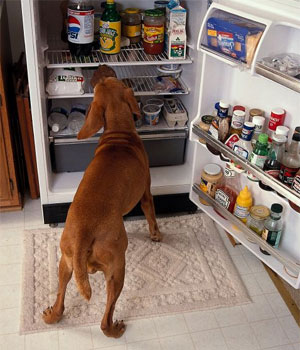
Dogs can’t always dine on the same things people do. Make sure you keep the following foods away from your dog, as even the smallest taste might be dangerous:
Alcoholic beverages
Avocado
Chocolate
Coffee
Macadamia nuts
Onions
Raisins and grapes
Xylitol (an artificial sweetener found in sugarless gum)
Yeast
2. Prevent a Kitchen Nightmare
There are other things to consider keeping away from your pet besides food. Dish soap, degreasing products, dishwasher tablets and steel-wool cleaning pads can all pose a health risk to a nosy pup. Consider using cabinet locks to keep your clean-up supplies away from curious canines, or store them out of the kitchen in a place where you can keep them up and out of reach.
3. The Rx for Safety
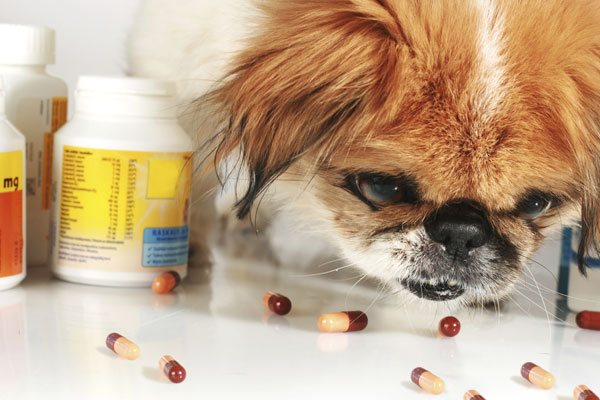
Keep your medication in its original, safety top containers, and store it high out of reach of your pet — preferably in child- or pet-proofed cabinets. With regard to flea medication prescriptions: Don’t give your dog flea medication prescribed for a cat, as these meds are not interchangeable among species. Cat-specific medications may contain additives that can harm your dog. Check with your veterinarian about flea medications that can accommodate both cats and dogs.
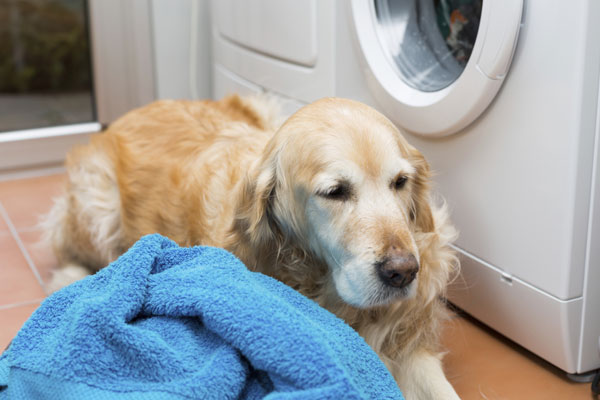
Similar to the kitchen, you’ll want to have a place to store your laundry supplies where they’ll be safely out of reach of your pet. Detergent, dryer sheets and stain removers are all potential poisons if your dog eats them.
Fresh flowers can make your home look and smell beautiful, but sometimes, dogs just can’t help themselves to a nibble or two … or twelve. Lilies, poinsettias, oleander and daffodils are all potentially poisonous if ingested, so keep temptation at bay by nixing the table floral decorations.
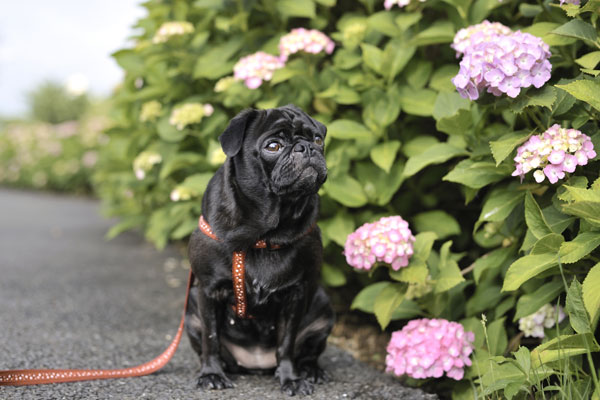
Poison safety doesn’t end once you step outside the house!
Landscape chemicals: Keep lawn and garden chemicals, such as fertilizer and weed killer, stored in a secure bin with a lid when you’re finished using them.
Garage chemicals: Bug spray, lighter fluid, gasoline, charcoal — if it’s in the garage or shed, it’s probably not suitable for your dog. The sweet smell and taste of anti-freeze is often enticing to most pets, but it can be fatal if ingested. Make it a habit to put all chemicals away before you leave the garage (in an out-of-the-way cabinet, if possible).
Trash: Invest in a tamper-proof garbage can that your pet can’t open. Trash bins are treasure (read: poison) troves for curious dogs. The potential for your dog to find and eat something he shouldn’t is too great with an unattended trash can.
Kimmel gave Peanut some sound advice: “I hope this doesn’t change who you are…it’s what’s on the inside that counts.”
He looks beautiful, doesn’t he?
There isn’t much you can change about Peanut to make him into a different dog. A bowtie and combing doesn’t change much about the pain and suffering this friendly dog went through to get to where he is.
A makeover is a nice gift, but truthfully Peanut should be proud to be who he is. You do you, Peanut. We love you just the way you are.
Peanut and his human live in Greenville, South Carolina. They entered Peanut in the contest in order to raise awareness around the subject of animal abuse.
History of the German Shepherd

The GSD’s history traces to the 1890s, when German calvary officer Capt. Max von Stephanitz sought to perfect a superior herding dog from his native country. He admired intelligent, strong dogs and saw many superior traits in native herding breeds. Despite his search, however, he didn’t find one that embodied his ideals until he attended a dog show with a friend in 1899.
Known as the father of the breed, von Stephanitz spied a dog named Hektor Linksrhein who impressed him so much that he purchased him on the spot and formed Verein für Deutsche Schäferhunde (SV), of Society for the German Shepherd Dog, later that year. This milestone in the GSD’s history marked its entry into the purebred-dog arena.
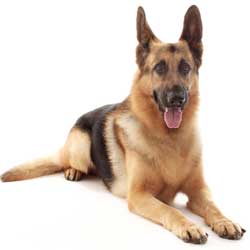
The German Shepherd Dog breed made its debut in the United States in the early 1900s and got its biggest boost in popularity after World War I when GSDs served as messenger, rescue, sentry and personal guard dogs alongside servicemen. Big-screen superstars Rin Tin Tin and Strongheart also helped promote the breed as loyal family dogs and home guardians.
The American Kennel Club recognized the German Shepherd Dog in 1908 as part of the registry’s Herding Group. Though the dogs retain their shepherding heritage, German Shepherds are now predominantly used as service animals and family companions. GSDs consistently remain near the top of the AKC’s most-registered breeds, securing their spot as one of the country’s most admired dogs.
Study Reveals Negative Effects of Sterilization in Goldens and Labs
Dog neutering is a very popular practice in the United States. In doing so, people hope to avoid overpopulation or various unwanted behaviors. But is it a good choice for dogs, health-wise?
The UC Davis School of Veterinary Medicine conducted a study with hopes of determining whether or not neutering is detrimental to canine health, and chose Golden Retrievers and Labrador Retrievers as their subjects. The two breeds, which have been accepted worldwide as exemplary family pets and service dogs, are very similar in behavioral disposition, body size, and conformation, and were labeled as conducive to a comparative study.
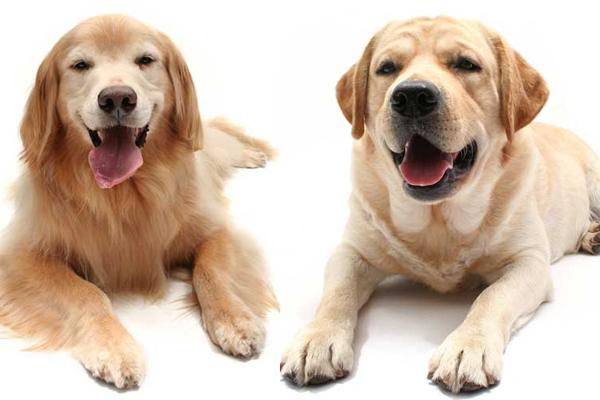
“…The incidence rates of both joint disorders and cancers at various neuter ages were much more pronounced in Golden Retrievers than in Labrador Retrievers,” notes Benjamin Hart, DVM, Ph.D., a distinguished professor emeritus in the School of Veterinary Medicine.
The long-term effects mentioned included joint disorders like hip dysplasia and cranial cruciate ligament tears, and cancers deemed “devastating”.
A connection was also found between early sterilization—before the animal is 6 months old—and the appearance of joint disorders. About 5 percent of intact Golden and Labrador Retrievers of both genders suffer from a joint disorder, the researchers determined. The rate in dogs sterilized before 6 months old jumped to 10 percent of Labs and 20 to 25 percent of Goldens.
The removal of hormone-producing organs during the first year of a dog’s life leaves the animals vulnerable to the delayed closure of long-bone growth plates, explains lead investigator Dr. Hart.
“We found in both breeds that neutering before the age of 6 months, which is common practice in the United States, significantly increased the occurrence of joint disorders, especially in the golden retrievers,” says Dr. Hart.
While neutering doubled joint disorders in Labradors, neutered Golden Retrievers saw their rate of joint disorder jump to four or five times that of Goldens that had not been neutered. Golden retrievers also saw a similar discrepancy in cancer rates, but with only female Goldens significantly affected. The study found that female Goldens that had been neutered had their risk of cancer rise three to four times that of non-neutered females.
The researchers did not take a stand on spaying and neutering, which is done to an estimated 83 percent of all U.S. dogs to control the pet population and prevent unwanted behaviors. Instead, they stated that the study served to measure the long-term health effects of sterilization and to educate breeders and dog owners who are deciding when, and if, to spay or neuter their animals.


|
A New Free Course on Dog Grooming Reveals the Secret Step-by-Step Techniques used by the best Dog Groomers in the country!
Finally, You Can Now Groom your Dog on your own at home without having to hire an expensive groomer! |